

Why a caravan needs its own alarm system
Unlike a motorhome, a caravan has no driver and usually no permanent on-board electrical supply — it just sits. That makes it more interesting to thieves: no owner in sight, no vibration from an idling engine, often only stabilisers and a hitch lock as visible security. A caravan alarm system therefore needs to do three things: detect motion, listen for sounds and alert you reliably — even off-grid.
Typical theft risks for caravans
- Hitching up and driving off: the entire caravan is connected to a tow vehicle and taken away.
- Forced entry through door or locker: the awning, interior or storage hatches are pried open.
- Damage in your absence: vandalism or break-in attempts that would otherwise go unnoticed.
- Theft of high-value gear: bicycles, awnings, tools, satellite kit and furniture.
A smart app-based solution like CampSecure™ ties these protections together: the phone evaluates motion and sound locally, attaches a photo to the alarm email and includes the GPS location — even when the caravan is already in motion.
Protection on the campsite
Camping life means you’re out and about: at the pool, restaurant, beach or trail — and your caravan stays on the pitch alone. A traditional siren-based alarm can easily be lost in the background noise of a busy campsite. A modern caravan alarm system for campsites has to notify you directly, not just make a noise — our caravan monitoring guide covers camera, sound and GPS in detail.
How CampSecure™ helps in everyday camping
- Immediate email on motion or sound: you see straight away if something is off — photo from inside the caravan included.
- GPS position in the alarm email: if the caravan is actually moved, you know exactly where it is.
- Daily status report: CampSecure™ sends a daily email at a time you choose (hour and minute, default 08:00) with photo, battery level and GPS.
- Discreet indoor solution: the alarm phone sits quietly inside the caravan — other campers don’t notice it.
Protection in winter storage
Between October and March most caravans stand still — in winter storage, in a barn, behind a hedge at a club site or simply on a friend’s plot. Many storage areas are only loosely fenced and known to opportunists. A caravan alarm system for winter storage therefore has to work reliably for months on end without supervision.
What a winter storage setup needs
- Low power consumption: CampSecure™ runs efficiently — with a sensible power supply the phone lasts a long time.
- Battery warning: when the phone’s battery drops below the configured threshold (5–50 %, default 30 %), the app sends a warning email in time.
- Daily status photo: a morning email tells you the caravan is still where it should be — without a 100-mile round trip.
- Sound detection in house mode: if the caravan is on stands in storage, motion sensitivity can be set to 0. The microphone keeps listening for forced-entry sounds.
Practical setup for winter storage
- Factory-reset an old Android phone (Android 10 or later, at least 3 GB RAM) and install only CampSecure™.
- Mount the phone inside the caravan, camera facing the door or main access point.
- Use a leisure battery or power station for permanent power; route the USB cable safely.
- Enter SMTP details for outgoing email and, optionally, IMAP for remote control.
- Enable the daily status email — e.g. 07:00.
- Set motion sensitivity to 0 (house mode), audio sensitivity to 4–6.
- Arm the alarm and lock up the caravan.
Motion and sound detection in detail
The two pillars of an app-based caravan alarm system are motion and sound detection. CampSecure™ evaluates both signals separately so you can fine-tune the alarm’s behaviour to your situation.
Motion detection
- Sensors: accelerometer + gyroscope on the smartphone.
- Sensitivity: 0 to 10, default 5.
- 0 = house mode: motion is fully ignored — ideal for stationary caravans on stands.
- 1–10 = vehicle mode: higher values mean more sensitive (e.g. on a busy seasonal pitch).
- The software filters small, harmless vibrations so that wind and rain don’t trigger constant alarms.
Sound detection
- Sensor: the phone’s microphone.
- Sensitivity: 1 to 10, default 5.
- Low values (1–3): only loud sounds trigger an alarm (e.g. forced prying).
- High values (7–10): sensitive — ideal for quiet locations (storage, barn, remote pitch).
- Runs in parallel with motion detection — a break-in attempt is cross-checked twice.
If you want to know how the sensitivity behaves in wind, rain or high campsite traffic, the user guide, section 5 documents every parameter, including ranges and recommendations.
Comparison: classic alarm systems vs. CampSecure™
Searching online for “caravan alarm system” turns up a wide range of products: simple wireless alarms, GSM modules, GPS trackers, premium installed systems. Here’s how CampSecure™ slots in:
| Solution | Typical cost | Photo on alarm | GPS location | Updatable |
|---|---|---|---|---|
| Basic wireless alarm | €50–€200 one-off | No | No | No |
| GSM alarm module | €100–€400 + SIM | No | Partial | Limited |
| Pro installed alarm | €500–€1,500 + installation | Rarely | With add-on tracker | No |
| GPS tracker | €50–€200 + SIM | No | Yes | Limited |
| CampSecure™ (app) | €3.99 / month Try 7 days free, then €3.99 / month. Cancel anytime. |
Yes | Yes | Yes |
Reminder: a smart app doesn’t replace mechanical security. The strongest setup combines a hitch lock, wheel lock or jockey wheel lock with CampSecure™ as the smart monitoring layer.
CampSecure™ as a low-cost caravan solution
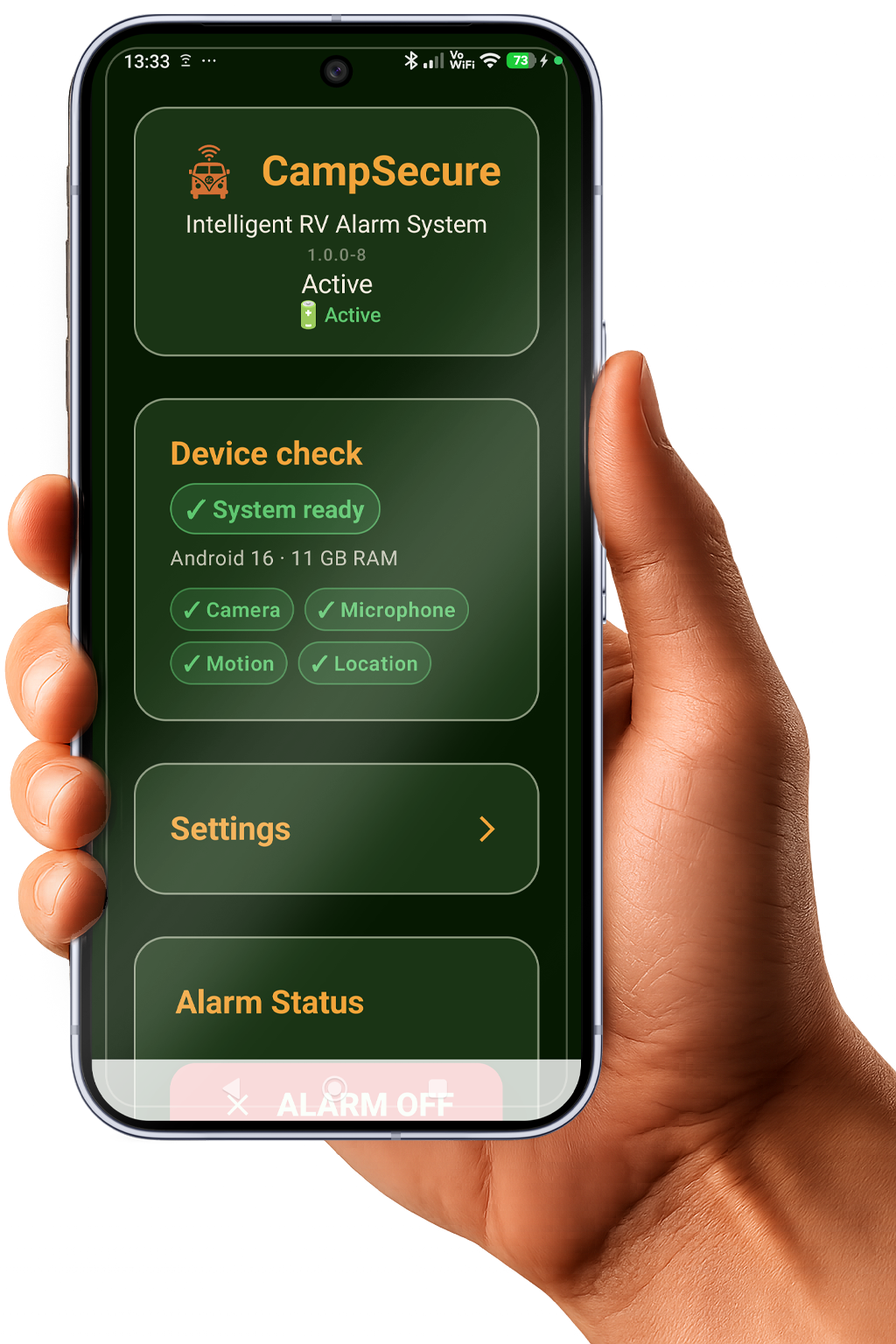
CampSecure™ is designed so you can start without buying anything extra — if you have an older Android phone sitting in a drawer, your upfront cost is €0. The app runs on any Android phone from version 10 onwards and unlocks the core protection features for caravans:
What CampSecure™ includes
- Motion and sound detection with individual sensitivity.
- Alarm email with photo and GPS location.
- Daily status report, scheduled to the minute.
- Remote control via Telegram or email (disarm, request status — email with whitelist and optional PIN).
- Automatic camera flash at night (lux threshold 5–50, default 20 lux).
- Battery warning at the configured threshold.
- Local processing — no mandatory cloud, no third-party tracking.
Advantages for caravan owners
- No investment in extra hardware.
- No workshop appointment, no permanent wiring.
- Updatable: new features arrive via app updates.
- Sustainable: an existing phone gets a second life instead of gathering dust — see also Old phone as alarm system.
- Predictable monthly cost: €3.99, cancel any time.
Try 7 days free, then €3.99 / month. Cancel anytime.
CampSecure™ as your caravan alarm system
Install the app, repurpose an Android phone, protect your caravan — on campsites, seasonal pitches and in winter storage.
Practical tips for your caravan alarm system
Power supply matters most
The most common reason for failure is an empty battery. Wire the alarm phone to a permanent power source — ideally a leisure battery with deep-discharge protection or a portable power station. The phone stays operational for weeks at a time.
Use the whitelist and PIN correctly
The email remote control follows a simple rule: only emails from addresses on the whitelist
are processed. For maximum security, set a 4-digit PIN — every command then has to include
it as ##1234##, otherwise the app ignores it. PIN 0000 disables the PIN check (whitelist only).
Switch on the daily status email
Even at the height of the season, a daily status photo in your inbox is reassuring. If something happens between status emails, you’ll still get the separate alarm email immediately.
Combine mechanical and smart security
A hitch lock raises the effort required to steal the caravan. Add smart alerting with GPS and photo and you also know in real time if the caravan is ever moved. That combination turns a “sticker on the window” into a real defence plan.
FAQ — Caravan alarm system
##aus## or request a status report with ##status##.
Activate your caravan alarm system today
With CampSecure™ your old Android phone becomes a smart caravan alarm system — on campsites, on seasonal pitches and in winter storage.
Disclaimer: CampSecure™ helps you monitor your property and alerts you to suspicious events. As with any technical solution, power supply, mobile signal, internet connection or device settings may affect operation. No guarantee can be given for the detection, triggering or delivery of every individual alarm.