If your motorhome, caravan or campervan is parked outside your home, keeping an eye on it takes almost no effort. You see it when you leave the house, walk past it on the way to the car or notice immediately if something looks different. Move that vehicle several miles away and a quick glance becomes a separate journey.
For leisure vehicle owners in some English cities, finding somewhere close to home is not straightforward. Parking rules differ from one council to another, but several local authorities place restrictions on caravans, trailers, motorhomes or larger vehicles in residential parking areas.
London: not every leisure vehicle qualifies for resident parking
London provides some clear examples. In Camden, a vehicle covered by a resident parking permit must not exceed 3.5 tonnes gross weight, 2.2 metres in width or 2.32 metres in height. The council also states that its resident permits do not allow trailer or caravan parking.
That does not exclude every campervan, but it can rule out many larger motorhomes. A conventional touring caravan cannot simply be added to the resident permit either.
Hackney has similar restrictions on its housing estates. The council states that a motorhome or caravan cannot be parked outside the home or on roads or land owned by the council without written permission.
These are local rules rather than a London-wide ban. They nevertheless show the difficulty owners can face when a leisure vehicle does not fit the same parking rules as an ordinary car.
Brighton & Hove goes considerably further
Brighton & Hove has particularly clear rules. Its resident parking permit conditions exclude vehicles constructed or adapted for human habitation. The definition also excludes caravans and trailers.
The council separately states that caravans and trailers cannot be stored on the public highway. Owners without suitable parking at home are advised to arrange storage at a dedicated compound.
That creates a very practical issue. Someone may own a perfectly legal caravan or campervan but still be unable to keep it in the same resident parking bays they use for an ordinary car.
Vehicle size can also decide whether you get a permit
Cambridgeshire County Council, which administers resident parking schemes in areas including Cambridge, sets another type of limit. Vehicles must be no more than 5.4 metres long to qualify for a permit and must fit completely within the parking bay.
Caravans, trailers and other non-motorised vehicles are not permitted in resident-only parking areas under the county policy.
A 5.4-metre limit is not unusual territory for a car, but many coachbuilt motorhomes are considerably longer. Even some larger campervans can fall outside it.
If there is no space at home, storage becomes the alternative
The advice given by Stevenage Borough Council is straightforward. Caravan owners who do not have suitable parking at home should arrange to keep the caravan at a storage compound. The council also warns that insurance may not cover a caravan while it is parked on the highway or other public land.
Private storage can solve the parking problem, and a professionally managed site may offer substantially better physical security than a residential street. Gates, access controls, lighting and CCTV can all make a difference.
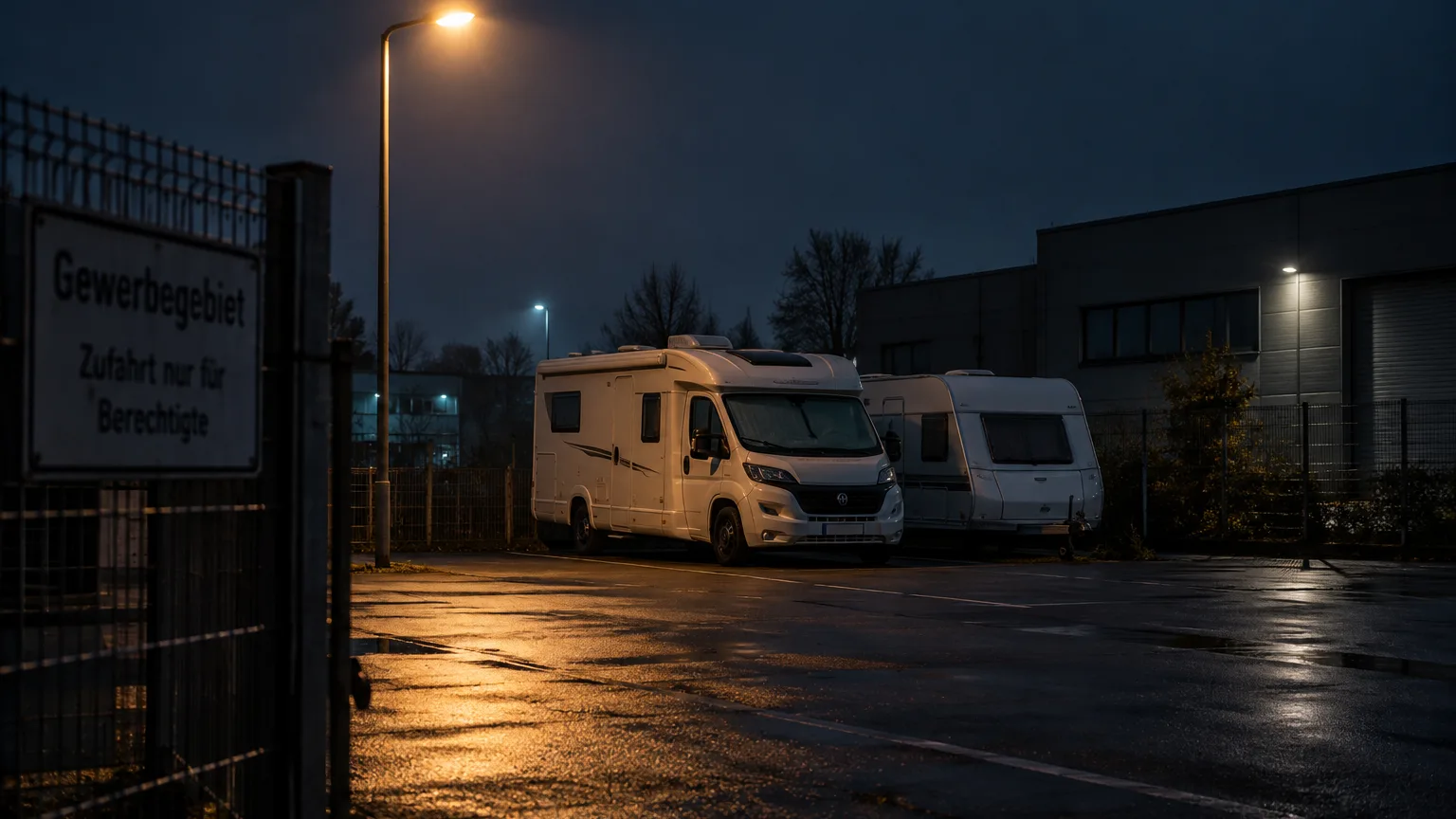
But moving a leisure vehicle into storage also changes the relationship between owner and vehicle. The caravan that used to be outside the house may now be on the edge of town. The motorhome may be in an industrial area several miles away. The campervan may sit behind a locked gate that the owner visits only occasionally.
The problem is not necessarily greater crime
There is no reliable evidence that simply parking a motorhome, caravan or campervan further from home automatically makes it more likely to be stolen or vandalised. A secure storage site can be safer than leaving a valuable vehicle on the street.
British police guidance does, however, make clear that the choice of storage location matters.
Nottinghamshire Police advises owners to use secure storage facilities with gated access, patrols and CCTV where possible. West Yorkshire Police similarly recommends checking the level of security offered by a storage site rather than choosing on price alone.
Police also recommend physical security such as wheel clamps and hitch locks, together with alarms and tracking systems. Avon and Somerset Police advises owners of caravans, campervans and motorhomes to consider approved alarms and tracking devices in addition to physical protection.
What disappears is the everyday check
There is another issue that locks and gates do not completely solve: the owner is no longer there.
When a caravan is outside the house, an open window is easy to spot. If a campervan has been moved, the owner notices. If something inside a motorhome looks different, it may be picked up quickly.
Once the vehicle is stored elsewhere, checking it means travelling to the site. Nobody wants to drive several miles every morning simply to confirm that the vehicle is still where it should be and that everything looks normal inside.
An old smartphone can provide that missing view
A smartphone already contains much of the technology needed to maintain contact with a parked leisure vehicle: a camera, GPS, mobile data and several sensors.
CampSecure uses that existing hardware. The Android app is developed by the publisher of this news site and turns an older smartphone left inside the motorhome, caravan or campervan into a remote monitoring device.
One of its functions is a daily status report. The owner can receive a current photograph from inside the vehicle together with its location and the smartphone’s battery status. Instead of travelling to the storage site simply to check, the first check can be made remotely.
The photograph can show whether the interior still looks as expected. The location can confirm that the vehicle remains where it was parked. Battery information shows whether the monitoring phone is still operating.
CampSecure does not replace secure storage, a wheel clamp, hitch lock, alarm or tracker. Those remain important. What it can provide is something different: a way to keep an eye on a motorhome, caravan or campervan when local parking rules or lack of space mean it can no longer stay just outside the front door.