
Full Article Text
A standard household refrigerator in a camper van? What initially sounds like an unusual solution has been working flawlessly for me for around two years. My refrigerator runs on 230 volts, holds approximately 90 liters, and consumes about 42 watts during compressor operation.
Technically, there is nothing inherently wrong with using a household refrigerator in a camper van. However, the electrical system of a caravan must meet specific requirements. The DIN VDE 0100-721 standard explicitly addresses electrical systems in caravans and motorhomes, while the DIN EN 1648-1 standard applies to 12-volt DC systems in caravans. Both standards are currently considered up-to-date by DIN Media.
The real question isn’t whether the refrigerator is labeled ‘Camping’—it’s more about proper installation and a power supply that matches the camper van and the devices being used.
Why I Installed a Standard 230V Refrigerator
I wanted as much usable fridge space as possible, so I chose a 90-liter household refrigerator without a freezer compartment.
The absence of a freezer compartment creates significantly more space for groceries. The temperature is adjusted normally via the built-in thermostat—nothing was altered or bypassed.
Additionally, a digital thermometer is placed inside the refrigerator, which has proven useful because the temperature near the rear cooling plate can sometimes drop so low that food may even begin to freeze.
During compressor operation, my refrigerator consumes around 42 watts. When the compressor starts, it may briefly require significantly more power. Therefore, a CampSecure™ inverter should not be selected solely based on the refrigerator’s continuous power consumption.
Two Years of Use Without Issues
A household refrigerator is not specifically designed for use in a moving camper van. That’s why I was curious to see how it handled vibrations during travel.
After around two years of use, I can report that my unit has been functioning perfectly. However, this is my personal experience and does not guarantee that every household appliance will work in every camper van.
The refrigerator must be securely fastened during travel, and the door must also be reliably secured.
Heat dissipation is equally important. In my model, heat is released through the side walls, so sufficient airflow must be maintained there. Other refrigerators have rear-mounted condensers or cooling fins. In any case, the manufacturer’s installation instructions must be followed.
The Refrigerator Runs Without Shore Power
The interesting part of my setup begins behind the power outlet.
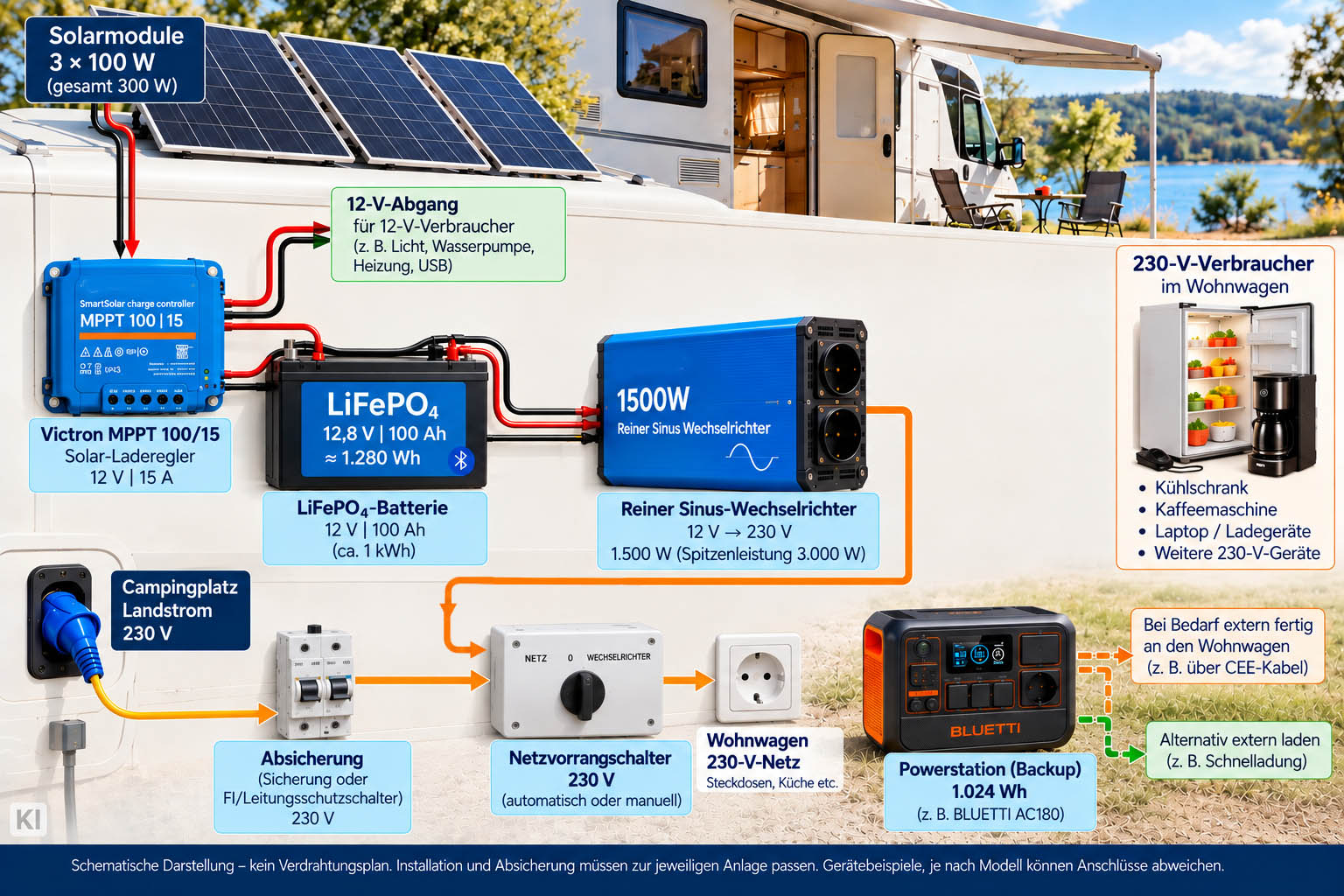
A LiFePO₄ battery with a capacity of approximately one kilowatt-hour serves as the main power source. Many other devices in the camper van, particularly lighting, remain connected directly to 12 volts.
A pure sine wave inverter handles the 230-volt devices. This allows the refrigerator to continue running even at campsites without shore power.
Three Solar Panels Deliver 300 Watts Peak
On the roof of my camper van, there are three flexible solar panels, each rated at 100 watts, totaling 300 watts peak (Wp).
The panels are installed flat on the roof. In practice, I’ve observed a maximum of approximately 170 watts of solar power in my system. This is not a guaranteed general value—solar output depends on factors such as sunlight angle, temperature, shading, orientation, and the type of panels used.
Charging is managed via a Victron SmartSolar MPPT 100/15.
Victron specifies a maximum battery charging current of 15 amps and a nominal PV power of 220 watts for a 12-volt system. The manufacturer also states a maximum PV open-circuit voltage of 100 volts and a maximum PV short-circuit current of 15 amps.
The 300 Wp on my roof does not mean 300 watts are being charged into the battery. In my case, the actual peak performance observed is significantly lower. If more power is available on the solar side, the charger limits its output based on its technical specifications.
This specific combination describes my existing setup. It is not a general recommendation to build 300-watt solar systems with an MPPT 100/15 charger.
Why I Would Use a 1,500-Watt Inverter Today
A large inverter would be unnecessary just for the refrigerator. However, my camper van also has devices that require significantly more power at times.
A good example is my De’Longhi Nespresso Lattissima+ coffee machine. When heating up, its power consumption is in a completely different range compared to the refrigerator.
This highlights an important difference:
The refrigerator requires relatively little power over an extended period, while a coffee machine needs a high amount of power for a short time.
For a new setup, I would therefore choose a pure sine wave inverter with around 1,500 watts continuous power and corresponding peak power today.
However, this generates substantial currents on the 12-volt side. Theoretically, 1,500 watts at 12 volts equals 125 amps. Due to inverter losses, the actual battery current could be even higher.
This is why inverters should be placed as close as possible to the battery. Wiring, connections, fuses, and other protective measures must be sized appropriately for the specific setup.
This article intentionally does not provide cable cross-sections or fuse sizes because these cannot be universally applied to another camper van.
Shore Power and Inverter Automatically Switch
My setup also includes an automatic mains priority switch.
When shore power is available, the 230-volt supply is operated directly through it. Without shore power, the designated devices can be powered via the battery and inverter.
In parallel, a separate 230-volt charger can recharge the LiFePO₄ battery when shore power is available.
My existing switching module is rated for a maximum of 10 amps. At 230 volts, 10 amps correspond to approximately 2,300 watts.
This does not mean that this value should be considered a target for continuous operation of multiple high-power devices.
Large appliances like electric grills, heaters, or air conditioners draw a lot of current. If multiple such devices run simultaneously, the existing circuit can quickly become overloaded. Therefore, these devices should not simply be connected via the small mains priority switch or inverter. A practical solution could be to provide a separate 230-volt outlet that is powered directly from the campsite connection when shore power is available. The permissible protection rating of the campsite and the electrical installation in the camper van must also be considered.
12 Volts Remain the Better Solution for Many Devices
Having an inverter does not mean the entire camper van is unnecessarily powered by 230 volts.
Lighting and other suitable devices continue to run directly from the 12-volt system, which has its own protected distribution.
The inverter can remain off when no 230-volt devices are in use, avoiding unnecessary power consumption.
The DIN EN 1648-1 standard outlines specific safety and functional requirements for 12-volt DC systems in the living area of caravans.
A Power Station Serves as Additional Backup
In addition to the permanently installed battery, I also have a power station with a capacity of 1,024 watt-hours.
It is not my primary power source but an additional energy reserve.
This provides a nominal total of about two kilowatt-hours of storage capacity from the fixed battery and the portable power station. The actual usable energy on the 230-volt side is reduced by conversion losses and reserves.
A major advantage of the power station is its mobility. If solar power is scarce for several days, I can take it with me, charge it quickly at an available 230-volt outlet, and then bring it back to the camper van.
This way, energy can practically be transported to the campsite.
In my setup, the power station can also take over the camper van’s power supply via the designated external 230-volt input when needed.
However, special caution is required: A power station is not electrically identical to a standard campsite connection. The output circuit, ground connection, residual current protection, and the specifications of the involved devices must match the connection concept.
This is explicitly not an area for improvised adapters or self-built connection solutions.
Power Station Instead of a Full Electrical Installation?
If someone does not want to build a complex fixed system with a large battery, inverter, and charging electronics, there is another option available today.
A sufficiently sized power station combines a battery, inverter, charger, electronics, and various safety features in a single unit.
For a small 230-volt refrigerator, this can be a much simpler solution. In particular, devices with LiFePO₄ batteries, around one kilowatt-hour of storage, sufficient 230-volt output power, and solar input are generally suitable.
The required power depends again on the actual connected devices.
My 230V Refrigerator Stays Installed
After around two years, I see no reason to remove the standard household refrigerator.
It offers ample fridge space, consumes about 42 watts during compressor operation in my model, and has so far handled the camper van’s movement without issues.
The key factor, however, is the system behind it.
A 230-volt refrigerator alone does not make a camper van self-sufficient. In my case, it’s the combination of a LiFePO₄ battery, three 100-watt solar panels, an MPPT charger, inverter, shore power supply, 12-volt distribution, and an additional CampSecure™ power station that makes it work.
Anyone planning a similar solution should not simply copy individual components but consider the entire electrical system.
Safety Notice
This article is a personal practical and experience report. It is not a construction, wiring, installation, or sizing guide and does not replace electrical planning or inspection.
Special technical requirements apply to electrical systems in caravans and motorhomes. The DIN VDE 0100-721 standard covers the electrical systems of caravans and motorhomes, including their connection lines to the campsite power supply.
Working on 230-volt systems can be life-threatening. Even in 12-volt systems, powerful batteries and inverters can generate currents of over 100 amps. Faulty wiring, connections, fuses, or protective measures can cause overheating and fire.
The performance values and components mentioned describe my specific setup and should not be transferred unchecked to another vehicle.
Work and modifications to the electrical system should be carried out in accordance with applicable technical regulations and, in particular in the 230-volt range, performed or inspected by a qualified electrician.